




You are using an out of date browser. It may not display this or other websites correctly.
You should upgrade or use an alternative browser.
You should upgrade or use an alternative browser.
R4 towing with A frame.
- Thread starter Renonut
- Start date

André4Renaults
Enthusiast
- Messages
- 834
- Location
- Barnet, Hertfordshire.
A Frames are a bit of a grey area as far as as the law goes. I had one for 20 years when working as a mechanic and used it for recovery work with a Subaru Forester 4x4 with roof beacon lights and I always wore a hi-vis jacket (or gilet, if in France....). I was never stopped by the "boys in blue", who drove past me, looked at the set up & probably decided I knew what I was doing (debatable!) I never exceeded 50 mph & usually stayed under 40. I always stopped after a few miles to double check the straps were tight and that all the lights were working. Motorways were best; no real corners, easy to read the road ahead and a hard shoulder if one needed it!
As I understand it, because all 4 wheels of the towed car are on the road it is classed as a trailer, and therefore it must weigh less than the maximum un-braked weight that the towing vehicle is able to tow. You would need to check this with the camper van company or ask a tow-hitch company for advice. Some more complex systems allow use of the towed vehicle's brakes, which then allows you to tow a heavier vehicle, since the braked allowance is more than the un-braked one. You'll also need a rear light board & number plate, with the necessary 10 pin connection to the camper van. It really depends on the size, weight and power of your camper van but do bear in mind that you'll need much more stopping distance, you'll have much less acceleration, you can't reverse and you'll need a bigger swing at roundabouts!
A Subaru Forester can pull a house down without breaking sweat & I never encountered any problems towing anything. It has a huge towing weight, even un braked, which I don't think I ever exceeded......
DM me if you think I can offer more advice!
As I understand it, because all 4 wheels of the towed car are on the road it is classed as a trailer, and therefore it must weigh less than the maximum un-braked weight that the towing vehicle is able to tow. You would need to check this with the camper van company or ask a tow-hitch company for advice. Some more complex systems allow use of the towed vehicle's brakes, which then allows you to tow a heavier vehicle, since the braked allowance is more than the un-braked one. You'll also need a rear light board & number plate, with the necessary 10 pin connection to the camper van. It really depends on the size, weight and power of your camper van but do bear in mind that you'll need much more stopping distance, you'll have much less acceleration, you can't reverse and you'll need a bigger swing at roundabouts!
A Subaru Forester can pull a house down without breaking sweat & I never encountered any problems towing anything. It has a huge towing weight, even un braked, which I don't think I ever exceeded......
DM me if you think I can offer more advice!
Last edited:
In the UK a trailer that has brakes, whether above or below the 750kg weight limit (at which point brakes become compulsory), must have those brakes in working order. Although the R4 is under 750kg - because it is being towed as a trailer, it's brakes must function.
I think there is possibly an exemption from this when using the recovery type A frame that André is describing, but the fixed type, that would typically need to be used behind a motorhome, certainly have this requirement.
The braking is typically achieved using a cable attached to the car's brake pedal and to the braking type tow hitch. There are electrically operated systems but they are quite expensive.
There are several UK companies that will do this work for you - it is necessary to fabricate special mountings for the a frame.
I have bought a second hand frame for mine (£150) but have yet to tackle the mounting of it.
I think there is possibly an exemption from this when using the recovery type A frame that André is describing, but the fixed type, that would typically need to be used behind a motorhome, certainly have this requirement.
The braking is typically achieved using a cable attached to the car's brake pedal and to the braking type tow hitch. There are electrically operated systems but they are quite expensive.
There are several UK companies that will do this work for you - it is necessary to fabricate special mountings for the a frame.
I have bought a second hand frame for mine (£150) but have yet to tackle the mounting of it.
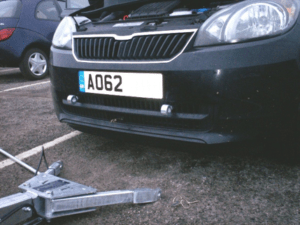
This is the type that I have -
André4Renaults
Enthusiast
- Messages
- 834
- Location
- Barnet, Hertfordshire.
Yes, D.G. is right about the 750Kg rule, and that the a trailer that has brakes they must be in working order, but the way I interpreted it when I was towing was that the trailer may well have brakes, and that they're in working order, but that doesn't mean they have to be in use when the vehicle is being towed. I've been told by colleagues that the units operating the trailer's brakes also work somewhat erratically, in a rather "all or nothing" way, but `I've never used one, so I wouldn't confirm it.In the UK a trailer that has brakes, whether above or below the 750kg weight limit (at which point brakes become compulsory), must have those brakes in working order. Although the R4 is under 750kg - because it is being towed as a trailer, it's brakes must function.
I think there is possibly an exemption from this when using the recovery type A frame that André is describing, but the fixed type, that would typically need to be used behind a motorhome, certainly have this requirement.
The braking is typically achieved using a cable attached to the car's brake pedal and to the braking type tow hitch. There are electrically operated systems but they are quite expensive.
There are several UK companies that will do this work for you - it is necessary to fabricate special mountings for the a frame.
I have bought a second hand frame for mine (£150) but have yet to tackle the mounting of it.
Another alternative might be a braked tow dolly; this would permit the Renault's front wheels to be off the road and would add comparatively little more to the G.T.W. (gross train weight) of the combination. As the Dolly would have brakes the whole set-up would be safer and you wouldn't put any mileage on the car! However, the question then is what one does with the dolly when you get to where one's going.......
André4Renaults
Enthusiast
- Messages
- 834
- Location
- Barnet, Hertfordshire.
Every make of car would be different, but as a rule the wishbones are good points to use. Do NOT use the steering rods or the driveshafts, as you'd bend the former and damage the latter! A front crossmember would also be a suitable point, although bear in mind that the forks of the A frame must be attached in such a way that they cannot slide along any bar or crossbeam.
Time spent carefully attaching the A frame is time well spent and took me quite bit of time every time I used mine. Obviously the steering lock, if fitted, must be in the OFF position. If the car doesn't have a position on the key without energising the ignition circuit (some don't) I used to switch the ignition on, but disconnect the feed to the coil, to prevent it burning out.
If you'd ever had to use an A frame to recover a car on the A40, in the dark, with traffic wizzing past you, while it's snowing and you're deep in slush I can assure you the novelty wears off very quickly! The memory is seared into my mind!
Time spent carefully attaching the A frame is time well spent and took me quite bit of time every time I used mine. Obviously the steering lock, if fitted, must be in the OFF position. If the car doesn't have a position on the key without energising the ignition circuit (some don't) I used to switch the ignition on, but disconnect the feed to the coil, to prevent it burning out.
If you'd ever had to use an A frame to recover a car on the A40, in the dark, with traffic wizzing past you, while it's snowing and you're deep in slush I can assure you the novelty wears off very quickly! The memory is seared into my mind!