

Clementine's Garage
Clementine the Cat
 
Image of flower
Yellow R4
 
Réparateur d'automobiles

High idle when hot

RJK91

Enthusiast
Messages
5
Location
Bristol
Hi everyone

My F4 van has an issue where the idle increases when the car gets hot and I'd like some help diagnosing the issue.

I had problems with a stuck choke cable and slack in the throttle cable. I replaced the choke cable and took up the slack in the throttle. These solved the high idle issue generally because the choke valve now opens up, but when the engine heat increases after a few minutes of running (particularly in traffic), the engine idle increases with it. The mixture seems far too rich when this is happening and it's like I'm Saddam Hussein gassing the Kurds with my exhaust gasses in traffic.

I've seen various threads about similar issues - it seems it can be due to fuel getting too hot before entering the engine and/or due to vacuum leaks. I think the engine may be getting a bit too hot generally so I'll change the coolant just in case. I'd appreciate any feedback because carburettors remain something of a mystery to me.

Thanks
 
If your exhaust's producing too much unburnt fuel either the mixture's too rich or the sparking plugs aren't fully burning the fuel that is being pumped into the engine. Do you need to use the choke to start the car when it's cold-really cold-as it would be on a morning after the car's stood in the open overnight? If you don't, and the engine starts easily, then I'd suggest the mixture setting is too rich, since it's normally necessary to pull the choke to start a cold engine.

The problem might be in the ignition system, and a 'dying' capacitor will function correctly when cold, but will fail to function as it become hot, when the internal insulation breaks down. Perhaps change the capacitor for a new one first and see if this cures things. It'll save your hands becoming unnecessarily dirty!

Report back your findings and thoughts. I'll suggest a few other ideas if needed!
 
Last edited:
The car actually came with a spare capacitor in it but I didn't know what it was until reading your post.

I installed the capacitor today and it resolved the issue - it now idles correctly even when warm. Thanks!
 
Hi again - on closer inspection, I think that the resolution was caused not by the fitting of the capacitor but rather by the fact that the subsequent drives were made in cold weather with the lights on. It seems that having the headlights on pretty much solves the issue of the rising idle.

I would therefore like to ask if anyone has any suggestions as to why this might be and how I might be able to change it so that the car idles correctly without the headlights on?
 
Yes, there are a number of possibilities:
1/ The car's battery is not in the best of health. In very cold weather the chemical reaction within the battery that generates the electricity slows down and the battery therefore produces less power. In these circumstances when the car's running the electrical load (lights, heater fan, wipers, heated rear window etc.) is more and if the battery's not in good health the electrics are more reliant on the dynamo. If more load is placed on the alternator/dynamo it will have an increased resistance and this will slow the fan belt running over the pulley, which will, in turn, slow the main engine crank, thus slowing the engine.

2/ If the car's fitted with a dynamo, as opposed to an alternator it's possible that the voltage regulator is incorrectly set, although this is unlikely, in my opinion. The voltage regulator compensates as the battery needs charging and reduces this charging rate as the battery reaches full capacity. It also compensates for the effects of low temperatures, and it's possible that this aspect of the regulator needs adjustment. Check your battery's capacitance first: this measures the battery's health and not merely the nominal voltage it can hold. If it's poor or weak, buy a new battery, as you're going to need one soon. In the summer a dying battery might hang on for a few months, but in very cold weather-forget it-you'll need a new one!

In my humble opinion (although based on more years than I care to remember spent repairing these systems!) you should set the car's tick-over speed with the engine warmed up and with no electrical load (lights etc.) switched on. Setting the tick-over's important, as too low a rate will cause stalling when moving off and too high a rate makes manoeuvring difficult.

More advice if you need it!
 
Thanks. I very much doubt it is the battery - I replaced the battery last year and it has a solar charger connected to it. Speaking of though, maybe I should disconnect the solar charger when the car is running?

The car has an alternator rather than a dynamo. To describe the car's electrics - they have always been weak but I don't really know what is typical for such a car. I was told when test driving not to leave lights, wipers and other electrics on when idling in traffic. Having the lights and indicators on at a junction too long causes the indicators to weaken and stop. Is that typical for an old Renault 4?
 
Hi

The indicators weakening and stopping is not normal. Is the alternator charging up the battery properly? Easy enough to run a check on the alternator with a meter. Another obvious thing to check is whether the alternator belt is slack and needs adjusting.
 
Does your alternator have an external regulator? If so, could that be the problem?
It'd be worth checking the fusebox and earth lead connections too.
 
Your car's behaviour is NOT normal, particularly as it sports an alternator! Alternators supply HUGE amounts of current and are particularly good at charging the battery even when the engine's on tick-over, so something's wrong. Try the following:

1/ Check the voltage at the battery when the engine's running and the lights are off: it should be 14.4 volts, (+/- 0.1v) Now switch the lights on; the voltage will drop and then stabilise back at 14.4 volts again. Any change from this would suggest a problem with the regulator.

2/ Check the battery's capacitance. This measures the battery's ability to hold a charge and deliver a high load (for a starting motor) for a given length of time. If it's not able to "give of its best" you may be looking at a new battery, despite having just bought it!

Report back with your discoveries........
 
Thanks everyone. I feel I'm getting somewhere with this.

I bought a multimeter today and tested the battery. Before turning the car on, it was 12.96v and with the car running it was 13.4-13.4v. With the headlights on and engine running, it was 14.3v. As for whether there's an external regulator, what should I look for, what does it look like? If there is a problem with the regulator is this a simple fix?

As for the alternator belt, it is shabby and old but the tension looks OK but this is my very amateur opinion.

Going back to my original hypothesis about heat - I disconnected the solar charger and did a cross country journey in it this week. The car definitely seems to be overheating in dense traffic:
- The increasing idle problem was present even in the dark in the cold with the lights on when stuck in motorway accident traffic
- Heavy rain landing on the bonnet was evaporating instantly
- Noticeable increase in temperature inside the car in traffic
- I checked the radiator overflow tank/bottle and there is visible rust in the water in there

Is this likely to be a separate issue to that of electrics? Thanks again.
 
If your van has an external regulator, under the bonnet there'll be a small box on the bulkhead - like the one in this picture:
1768764767041.jpeg
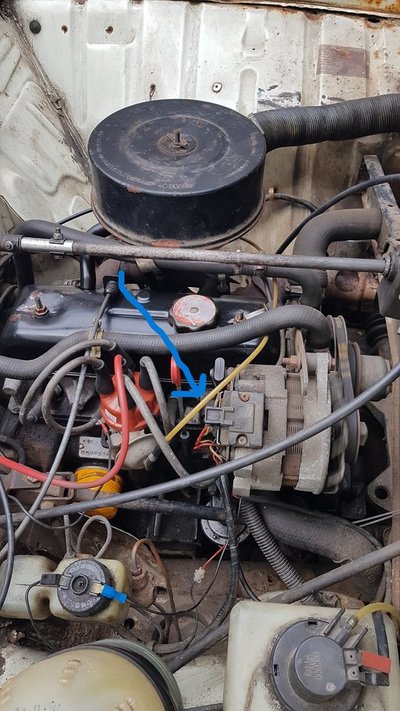
If the alternator wires go to a black plastic plug in the top of the alternator, the regulator will be built in:
1768765717311.jpeg
You don't say whether your van has an 845cc engine - like the one above - or an 1108, but judging by your photo of the speedometer, it'll be pre 82/83.
It'd certainly be worth replacing and checking the tension of both drive belts.
Gunge in the expansion chamber is an R4 classic - if it's there, it'll be elsewhere. It'd be worth flushing the system (if your van's overheating in January, it'll only get worse). Once you've got everything clean and back together, make sure you bleed the system - if there's still air in the system, the van will overheat.
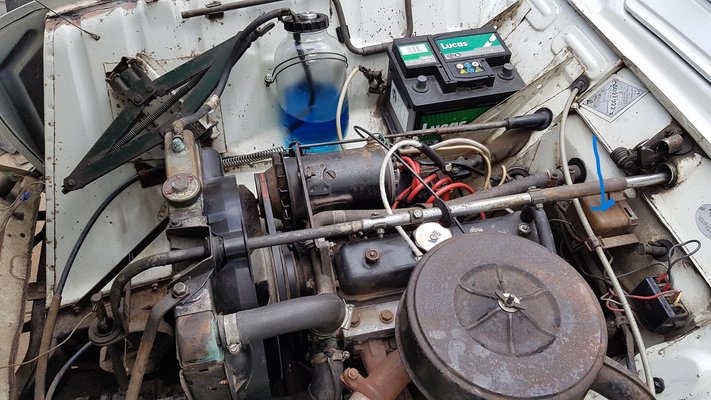
A few underbonnet photos would be helpful.
If the van has an external regulator, I might have a secondhand replacement.
Good luck!
Useful guides here:
845 engines (Billancourt): https://www.la4ldesylvie.fr/vidange...ncourt?highlight=WyJyZWZyb2lkaXNzZW1lbnQiXQ==
1108 (Cléon): https://www.la4ldesylvie.fr/vidange...-cleon?highlight=WyJyZWZyb2lkaXNzZW1lbnQiXQ==
 
I've read your latest report with interest and am of the opinion that the cooling system needs to be flushed thoroughly before investigating any electrical systems. Air locks, blockages and non-functioning thermostats would cause some or all of your symptoms. Flushing the system's not difficult, but is time consuming. There are plenty of blogs covering this on the Forum, so you'll not want for any help!

A few other things that I'd comment on as well:
1/ Heavy rain evaporating quickly is quite normal, although when I was a mechanic in the late 1970s we were often called out to cars whose drivers had mistaken this for steam escaping from the engine! It rarely, if ever, was!
2/ The increase in heat within the car in traffic points to a fault in the cooling system, as suggested earlier.
3/ "Crud" in the overflow tank suggests the same as above.

One other thought: One of the effects of removing lead from petrol in the 1980s was to increase the volatility of the fuel, which tended to make engines run hotter than they did. Although a marginal factor, I thought it was worth mentioning. Have you done a compression test? This might help confirm the health (or otherwise) of the head gasket, the failure of which might cause these symptoms.
 
Choke cable not set right would be my guess - I recall a similar issue. It's not intuitive to set. There is a lever that increases throttle in the choke and well recommended to make sure there is some slack in the choke before that starts operating. Same for throttle cable - just a little slack before they operate.
 
Last edited:
Back
Top