
Fitting new Points
The directions of rotation on this page apply to the Renault 4 1100cc engines. Some of the earlier engines turned in the opposite direction to make them easier to start using a starting handle.
The Renault 4 rotor arm turns in a clockwise direction, so the distributor will need to be twisted clockwise to retard the ignition and anti-clockwise to advance. Frederick the Frog has found paintbrush on the computer and was able to annotate the photograph.
This is a Femsa Distributor (with the distributor cap removed). The points are a bit of a hassle to replace as they are hidden underneath the contact plate inside the distributor.
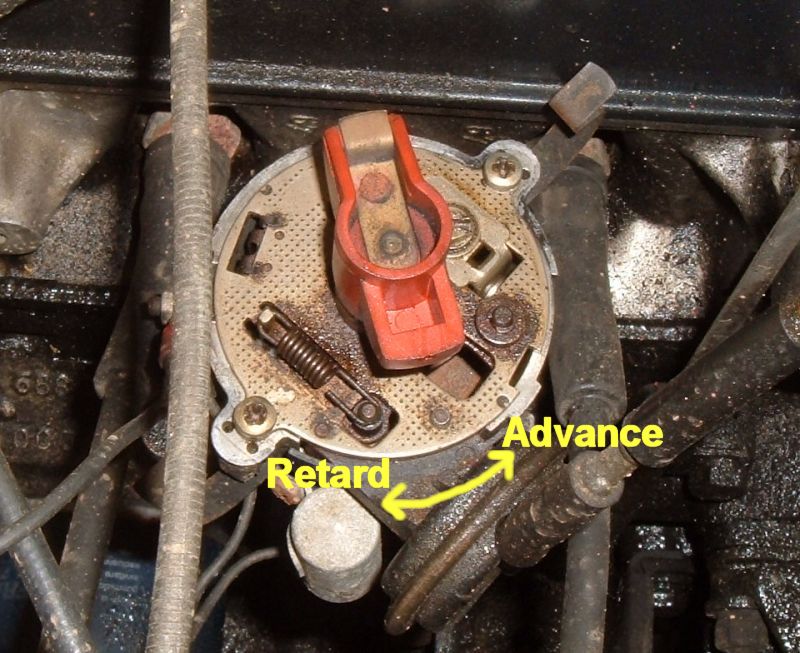
Frederick likes to remove the distributor from the car (marking the position before removing it) as that make it easier to set the points gap, but it's just as easy to leave the distributor on the car.
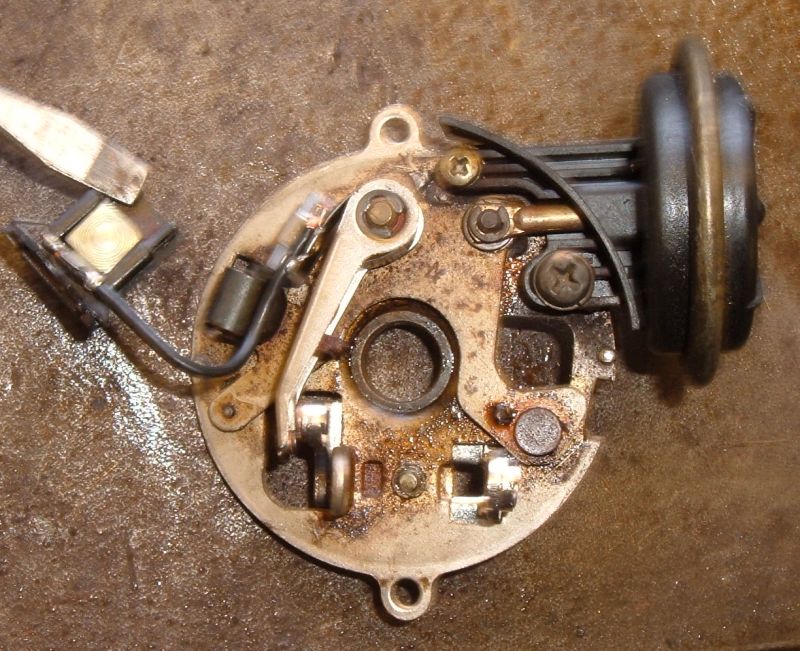
The contact plate will wiggle off the distributor once the two crosshead screws have been undone.
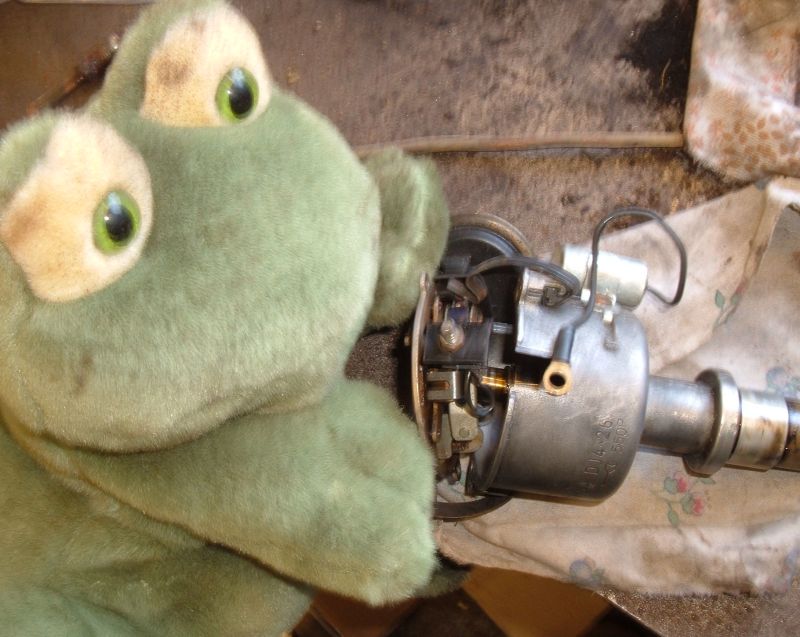
The contact points are in two parts. One is held on by a circlip and the other is screwed to the contact plate. For some reason sets of replacement points never seem to include a new circlip in the box, so you need to be very careful that the old one doesn't ping across the garage when you remove it.
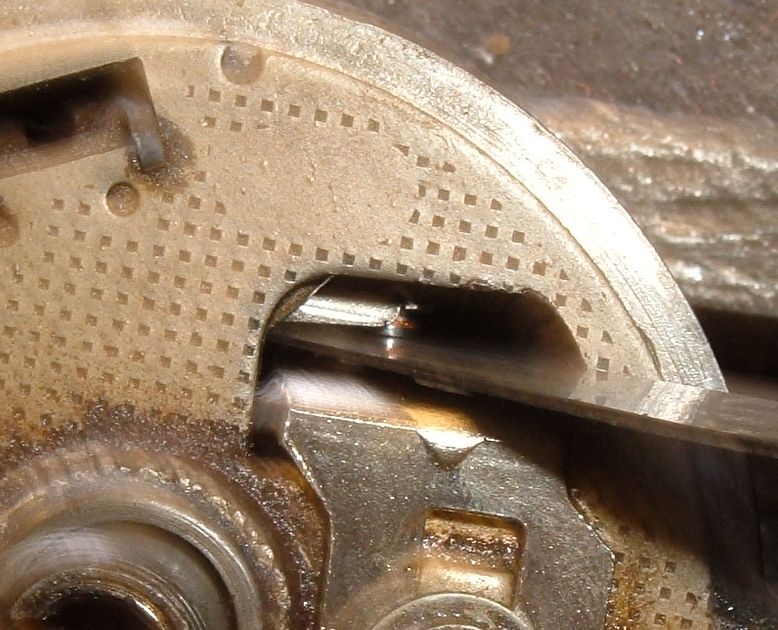
Next is setting the points gap. There is a handy hole in the contact plate to stick some feeler gauges down. The manual suggests using a dwell meter to set the dwell to 54 to 60 degrees, although for people who don't possess such a piece of equipment a good starting point is a gap of 0.4mm.
The points gap needs to be set when the points are at the highest point of the cam and the gap is at it's widest. If the distributor is still on the car it can be placed in 3rd or 4th gear and rolled until the gap is at it's widest.
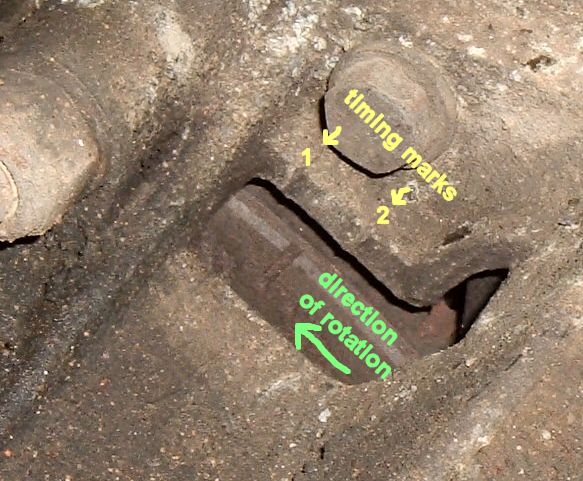
It's tricky to see the raised marks on the crankcase so I've arrowed them.
The manual suggests using a strobe light, unplugging the vacuum advance pipe from the distributor and to set the timing so that the notch on the flywheel lines up with the timing mark numbered 2 in the photo. That's all very well for leaded petrol, but for unleaded it makes sense to set the timing so the mark on the flywheel is roughly in the middle of the two marks.
For interest, mark 1 is top dead center (the piston at the top of it's stroke). Mark 2 is slightly advanced.
The distributor cap seems to need replacing as often as the points, or at the very least the 4 contacts inside will need to have the corrosion scraped off every now and again.
The Renault 4 is sensitive to timing as it runs a lean mixture aimed at efficiency. Here's some help with fault finding:
Too Advanced - Symptoms: The car feels jerky at light throttle at around 30mph (50km/h). The engine pinks at mid to full throttle at low engine speeds, particularly up hill and immediately after changing gear. Pinking sounds like a metallic rattle - as if you had a box of wine glasses rattling around under the bonnet. When the car is really advanced the engine will jerk on the starter motor rather than turn evenly.
Too Retarded - Symptoms: The car feels dull and slow - there is a delay between pressing the throttle and accelerating away, and the engine might sound a little more noisy than normal.
Back to Tech Tips




Engine
Electrical
Suspension
Front suspension lower balljoint
Brakes and hubs
Other
Frederick's angle grinder (RIP)